I have been trying to reconcile the concept of ‘mindfulness’ with the creative impulse. I find I cannot be mindful and creative – always dealing with ideas, potentials and possibilities – at the same time. It is an impossibility. Lets unpack it – with an examination on the nature of the Divine.
What is the nature of God? God is an endlessly creative being – the being which IS the numinous with all the potentials and possibilities, and recreating Truth, day by day.
What is the nature of Christ? Christ is the temporal being – incarnated as a man in the phenomenal to point out the Way.
What is the nature of the Holy Spirit? She is the ever present life-force that we transcend to when we engage in mindfulness.
Christ says: “I am the Way, the Truth, and the Life.” [John 14:6]
In this saying, Christ directs us to the Trinitarian nature of the Divine. The Creator is the Way – building and potentialising. Christ is the Truth – incarnated and revealing. The Spirit is the Life – ever present. We can be ‘present’ with the Holy Spirit in mindfulness, we can listen and ‘understand’ the words of Christ as he tries to tell us the way, and we can be one with the Creator god when we empower our own creativity. Do not let anyone take the power you have to be creative away from you. It is through this impulse that we will know the heart of God.
Therefore, we shall engage in all three. I listen to the words of Christ, I will find time to be present with the Holy Spirit, and I will follow my creative impulse without doubt.
Christ says: “Recognise what is in your sight, and that which is hidden from you will become plain to you. For there is nothing hidden which will not be manifest.” [Gospel of Thomas, 5]
We, as artists, poets and scientists – are chipping away at the numinous field. We are chasers of God.
Apparently when you
Square a Circle in a Pentagram
you get a woman over the moon.
The marriage of heaven and earth,
sometimes drawn by artists, geometers and conspiratorials
as a Circle Squared with Equal Circumference,
or Area – whichever you prefer.
And, with this same centre point,
set comfortably within the Pentagram… it leaves a gap
for the Moon… and the proportions
of a Woman Fivefold.
G. Barnes (2013) Squared Circle, Woman, and Moon in Pentagram [Pencil and tempera wash on paper]I think. I am yet to confirm the perfect shape of woman.
And not only that, but a Moon that is in fact, in an exact ratio to the Earth.
As per in space – real space – as measured by students studying ASTRONOMY 101.
Surely,
if Leonardo had have spent less time on war machines,
less time trying to fly and failing (flailing)
less time butchering,
begging,
and brotheling.
Less time positioning Man’s navel as the center of everything,
that strange herniac creature, that cadavar of ‘perfect proportion’.
He would have seen what is obvious to all cooks and cleaners and cheesemakers
– and artists with half a brain making vague scribbles in a fog of maths.
That the Squaring of a Circle, when in perfect alignment around a perfect center.
And, when within that fated shape of Platonic perfection. The Pentad Polyhedra
Ridiculed since the Renaissance and forced into the service
of fantasy for demons
and devils of fiction
with witches and warlocks,
for fear,
that it maybe the key,
to her and she,
together beyond patriarchy.
This final and mysterious shape /a perfect solid –
Could it be the shape of a universe emasculated?
(I mean encapsulated)
Beyond and before, this icon of misguided Humanism.
With legs astride, in extension; the universe embraced in limbs.
Centered in pleasure. Squared in pain.
Engaged to the Moon in Birth and Death.
Married to Earth.
Transfigured with Heaven.
In constant Expansion and Contraction through the Universe.
G. Barnes. November, 2013
NOTES
Wenzel Jamnitzer (1958) Perspectiva Corporum Regularium. Pentad polyhedra: The Platonic regular Dodecahedron is the first one.
THE PENTAD
Seen most obviously as the five-pointed star (pentagram) or a polygon of five sides (pentagon). In a regular pentagon, all sides are equal in length and each interior angle is 108°. A regular pentagon has five lines of reflectional symmetry, (five fold symmetry) and rotational symmetry also in order of 5 (through 72°, 144°, 216° and 288°). The diagonals of a regular pentagon are also, beautifully, in golden ratio to its sides. These diagonals can be calculated based upon the golden ratio φ and the known side T:
When mapped into three dimensions the pentad creates the dodecahedron – which is Plato’s last and final perfect solid. [There are only 5 regular solids in the world that can be constructed with regular faces.] It is composed of 12 regular pentagonal faces, with three meeting at each vertex, and has 20 vertices, 30 edges and 160 diagonals.
The dodecahedron was the last of the Platonic solids to be discovered. In Plato’s dialogue Timaeus (c. 360 B.C.) he associates the other four platonic solids with the four classical elements, adding that there is a fifth figure – the dodecahedron which “God used in the delineation of the universe” – to shape the universe – and which is associated with the element ‘aether’ – ie cosmic dust?
Recently, various models have been proposed for the global geometry of the universe. In addition to the primitive geometries, these proposals include the Poincaré dodecahedral space, a positively curved space consisting of a dodecahedron whose opposite faces correspond (with a small twist). This was proposed by Jean-Pierre Luminet and colleagues in 2003. (Physics World) They predict a model in which space consists of 12 curved pentagons joined together in a sphere. Their ‘small’, closed universe should be about 30 billion light years across.
“Our work really addresses this ancient question of whether the universe is finite or infinite, the exciting point is that this is no longer pure speculation – we now have real data.” (Jeff Weeks, Physics World)
The pentad was revered by many early societies: it is found throughout nature – from flowers, to apple cores, to the very shape of the universe. It is a symbol of life and regeneration. It is the five wounds of Christ, it is a symbol for truth.
SQUARING THE CIRCLE
Earth | Moon. Ratio
Circle Circumference Formula: CC = πd
Squared Circle Circumference CC/4=W
Circle Area Formula: AC = πr2
Squared Circle Area: √AC = w
The smaller circle (moon) is a circle with the radius of the gap between the squared circle and the square. It also has the diameter of the gap between the polygram and the square/circle.
The Moon is 3,476 km wide, the Earth is 12,742 km wide.
12742/3476 = 3.665 ratio
My picture: 1258 /297 = 4.11 ratio
NB. My pentagram was not perfect to start with! Therefore the squaring was a bit rough… The transcendence of pi implies the impossibility of exactly “circling” the square, as well as of squaring the circle. It is at best an approximation of the ‘truth’, as is all art and life!
VITRUVIAN MAN
Leonardo Da Vinci “The Viturvian Man” 1564 [watercolour]Leonardo’s Vitruvian Man is NOT an accurate squared circle. Many commentators have tried to apply this geometric concept to it, but it is not a squared circle by area or circumference. I measured it! His circle was merely inscribed within the square from the navel – although it is close.
This image does provide an example of Leonardo’s interest in the proportion of ‘man’. In addition, this picture represents a cornerstone of Leonardo’s attempts to relate Fivefold Man to Nature. He conceived of the human body as a cosmografia del minor mondo (cosmography of the microcosm), to be an analogy for the workings of the universe.
It is called the Vitrivius Man because Leonardo applied Vitrivius’ proportions of man from his architectural treatise. Man = temple. I wonder what a temple designed around a woman’s body would look like?
“Similarly, in the members of a temple there ought to be the greatest harmony in the symmetrical relations of the different parts to the general magnitude of the whole. Then again, in the human body the central point is naturally the navel. For if a man be placed flat on his back, with his hands and feet extended, and a pair of compasses centred at his navel, the fingers and toes of his two hands and feet will touch the circumference of a circle described therefrom. And just as the human body yields a circular outline, so too a square figure may be found from it. For if we measure the distance from the soles of the feet to the top of the head, and then apply that measure to the outstretched arms, the breadth will be found to be the same as the height, as in the case of plane surfaces which are perfectly square. [Vitruvius, pg.73.]
Critchlow, Keith.(1999) Islamic Patterns: An Analytical and Cosmological Approach. Inner Traditions, rochester, Vermont.
Hemerway, Priya. (2008) The Secret Code. The Mysterious Formula that rules art, nature and science. Springwood; Lugano, Switzerland.
Lundy, Miranda. (1998) SacredGeometry. Walker & Company; New York.
Pastorello, Tom. Leonardo Squared the Circle! — Da Vinci’s Secret Solution in the Vitruvian Man Decoded. Retrieved from: http://arthistory.about.com/library/weekly/bl_leo_vitruvian_man.htm
Vitruvius. The Ten Books on Architecture. Translated by Morris Hicky Morgan, Harvard University Press, Cambridge (1914). Retrieved from: http://www.gutenberg.org/files/20239/20239-h/29239-h.htm#Page_72
In the beginning God created the heaven and the earth.
Spirit and Matter began separate. They asked themselves why are we not of the same substance? As heaven yearns to rest lightly on Earth, Earth yearns to rise to heaven. And within this forever yearning, valleys are pushed into the sky and mountains crushed into the sea.
We have learnt that we cannot exist without one another.
2
And the earth was without form, and void; and darkness was upon the face of the deep.
And the Spirit of God moved upon the face of the waters.
I am in heaven, and I am lonely here apart from all that is real. There is no glue to bind my flailing spirit. There is no blood to race when my spirit passes over your valleys. I have no pulse, I have no cell, no soul, no eye to see or finger to touch. I pass through your substance – silently searching for somewhere to rest. I long to stop and grow, to find a place in you where I may be.
3
And God said, Let there be light: and there was light.
Here am I, Oh Heaven, I am here. I can cry. I am Earth. I have tears and they weep for your loneliness. Endless rivers of sadness, leading to large pools of sweat and salt. Where are you, why can you not stop with me? I am alive, I will grow, I will find you.
4
And God saw the light, that it was good: and God divided the light from the darkness.
I turn to the light, are you in the light? The swamp dries. Mud disappears. I follow the light and the worms burrow deeper inside my flesh. They turn from your light. The white light is my guide, it will lead me to you.
5
And God called the light Day, and the darkness he called Night. And the evening and the morning were the first day.
In the Day I will search for rest, and in the Night I will gently call your name. Everyday and every night, until you hear me and make a space. As my light spills across your body, you awake and groan. Heaven is upon you, rise and meet me! Let me enter!
“Mother of God of the Sign” [G.Barnes, 2013. Egg tempera and gold on board. Sacred Heart Catholic Church, Addington]By G. Barnes (2006)
“Cosmic Hole of Glory” [Photoshop Study]As a human being in the 21st century I am overwhelmed by a saturation of facts; an environment of e-knowledge too impossible to comprehend,
too perplexing to remedy,
too pointless to sustain, to make sense of.
Our technology grows more inscrutable, our politics more convoluted, foreign policy beyond madness, rules expand, legislation grows, libraries thicken, archives burst. So much to learn, in one life, a tiny lifetime to learn so much.
Where are my ancestors? Who hands down the wisdom? [Just the important bits please.]
As an artist in New Zealand 2013 I am overwhelmed by too many choices: a saturation of imagery, beauty absorbed by capitalist propaganda, materialist agendas, art objects sold, weighed, cut by 40%, add %15, taxed at %19.
Nature divided – birds, insects, human parts rearranged, reconfigured.
In the cafe, the restaurant, the office.
To the hearth, the lounge wall, the foyer.
the rhetoric
the memory
the original
the ego
the statement.
Then it becomes a poster, a jpeg,
if you are lucky … a file in a vault.
As a spiritual being at the dawn of this new millenium I am overwhelmed by religious fervour, embarrassed by fundamental insistences, God appearing in broken people,
Christ not walking among us, breaking his own bread, sharing wine with us.
A memory of Israelites. Engrained. Embellished.
A diffuse Divine,
absent in the modern
we reincarnate the Ancients
we summon the Dead
we invoke the Saints
we need their wisdom to be … so very infused, absorbed, engrained at the core!
– where we don’t have to think or measure the weight of it.
Nor even the reality of it.
Just their wisdom please, a wisdom that our genes seem to have lost somewhere along the line.
Bees. Four days work.
Why are we not like the Bees? Who for millions of years, billions of generations have built the exact same hive. A hexagon. Do the young’ns say – ‘lets build something modern! Lets innovate! A circle perhaps?” And do the old’ns say – “We tried that once, little fella – didn’t work.” Four thousand new bees swarm in our hive at the back of the garden. They got straight to work and began to build baby houses for their Queen’s brood. The same as they have ever done. Soon there will be 20,000. And honey. Hopefully. But quite likely.
A few stragglers wander into my studio and alight on the gilded surfaces.
Is Heaven for all the billions? The Divine soul is listening; Empathic souls hear every cry. Blimey, it must be exhausting!
Have you worked out that it is between the lines that we work? That poetry and painting reveal the spaces between the saturation? I cannot think in prose this week, I cannot apply logic and coherence to my thoughts – actually I am refusing to do so. I am finding my reality in parallel, in simultaneousness, and vague intuition. Legitimately.
I am not a computer who can manage my information efficiently.
Sort, stack, assemble, pattern, sample, divide and conquer.
Linear processing and serial deduction to reach sequential conclusions.
“Once Copernicus had eliminated place as a basis of the human claim to centrality in the universe, we were at a lost to interpret our spatial experience simultaneously. Descartes replaced it with the reality of our own mental processes -he coined the famous dictum “I think, therefore I am”- a few words which displaced spatial experience, created a referential void, and further disassociated us from our passages of life.” [G. Barnes, From An Essay I wrote when I could think logically. 1995. University of Otago]
Lunar Virgin, Suburban Mary [60x45cm, egg tempera and gilding on gessoed board.]Place. Space. And Being.
A thought,
that maybe the wisdom, humility and mothering spirit of the ancient soul of the Virgin Mary could be invoked in the violent nights of suburban New Zealand. That angry hands be stayed. That the child sleeps in peace, comfort, joy.
another thought,
that the astronaut, in terror descends the lunar surface, looks back at the Earth.
It floats alone, a small sliver of oxygen holding back an infinity of piercing cosmic dust.
Wisdom is imparted from our ancestors, from celestial travellers.
Are we listening? No – that’s not the right question – I mean –
“St Francis with Birds of Aotearoa” [Egg tempera and gilding on gessoed board, 38x25cm]
Saint Francis (b. 1181) was an Italian Catholic friar and preacher. He founded the men’s Order of Friars Minor, the women’s Order of St. Clare, and the Third Order of Saint Francis. Francis is one of the most venerated and painted religious figures in history. ‘To rekindle the love of God in the world and reanimate the life of the spirit in the hearts of men’ — this was his mission.
Francis was a profound mystic in the truest sense of the word. The whole world was to him one luminous ladder, upon the rungs of which he approached and beheld God. He profoundly united religion and nature – finding in all created things, however trivial, some reflection of the Divine perfection. (See his famous poem “Canticle of the Creatures” below.) He loved to admire in them the beauty, power, wisdom, and goodness of their Creator. He saw a sermon in stones, and good in everything. He delighted to commune with the wild flowers, the crystal spring, the friendly fire, and to greet the sun as it rose.
The very animals found in Francis a tender friend and protector and the early legends have left us many an idyllic picture of how beasts and birds alike were susceptible to the charm of Francis’s gentle ways, and entered into loving companionship with him. How his “little brethren the birds” listened so devoutly to his sermons that Francis chided himself for not having thought of preaching to them before. A winning trait of Francis which inspires the deepest affection was his unswerving directness of purpose and unfaltering following after an ideal. “His dearest desire so long as he lived”, Celano tells us, “was ever to seek among wise and simple, perfect and imperfect, the means to walk in the way of truth.” To Francis love was the truest of all truths; hence his deep sense of personal responsibility towards his fellows. Hardly less engaging than his boundless sense of fellow-feeling was Francis’s downright sincerity and artless simplicity. Humility was, no doubt, the saint’s ruling virtue. He truly believed himself less than the least.
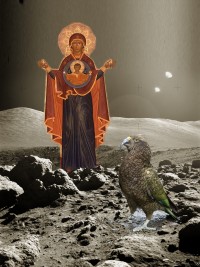
For many thousands of years the birds had dominion over the islands of New Zealand, but human settlement forced the extinction of many, and several species are currently endangered. New Zealand has lost more bird species than any other nation. Of those remaining we now have a higher percentage at risk than any other country. Yet they will continue to hold their place in this land – intimately connected with the forest, the mountains and the shorelines. During Francis’ lifetime, they would have been abundant. The Kea, in the bottom of the image, is considered to be a guardian. In Francis’ right hand he holds one of our most endangered birds – the black robin – which was once reduced to one breeding pair. [more info]
The Praise of the Creatures
(Written by St. Francis)
Most high, all powerful, all good Lord!
All praise is Yours all glory, honour and blessing.
To You alone, Most High, do they belong.
No mortal lips are worthy to pronounce Your name.
Praised be You, my Lord, through all Your creatures,
especially through my lord Brother Sun,
who brings the day; and You give light through him.
He is most beautiful and radiant in all his splendour!
He bears the essence, of You, Most High.
Praised be You, my Lord, through Sister Moon
and the Stars, in heaven you formed them
clear and precious and beautiful.
Praised be You, my Lord, through Brother Wind,
and through air serene and stormy clouds,
through every kind of weather
You give sustenance to Your creatures.
Praised be You, my Lord, through Sister Water;
She is very useful, humble, precious and chaste.
Praised be You, my Lord, through Brother Fire,
through whom You light the night.
He is beautiful and cheerful, robust and strong.
Praised be You, my Lord, through our sister Mother Earth,
who feeds and sustains us, who rules and governs us
Who produces many fruits and colourful flowers and herbs.
{abridged}
Praise and bless my Lord and give Him thanks
and serve Him with great humility.
The Transfiguration is the event when Christ’s two natures are made clearly visible. In front of human witnesses – Christ exchanges his temporal earthly form for his eternal divine form for a moment…
The Transfiguration was not a phenomenon circumscribed in time and space; Christ underwent no change at that moment, even in His human nature – the change occurred in the awareness of the apostles, who for a time received the power to see their Master as He was, resplendent in the eternal light of the Godhead. The light which Christ radiated on Mount Tabor is eternal and is visible through reflection, introspection and the silence of inward prayer – waiting upon God in emptiness and quietness.
The Transfiguration is one of the greatest mysteries of the Christian revelation, and one that is important to icon painters – it gives us permission to attempt to portray the divine light of God – which is in the likeness of Christ. A mystery is something that while it may be revealed for our understanding, we can never understand it exhaustively. It leads us into the depth, and into the darkness of God. The eyes are closed – but they are also opened.
And Christ was transfigured before them (Peter, James and John): and his face did shine as the sun, and his raiment was as white as the light. …[Peter then expressed how good it was to be there and suggested perhaps they build some sort of altar] … While he yet spake, behold, a bright cloud overshadowed them: and behold a voice out of the cloud, which said, This is my beloved Son, in whom I Am well pleased; hear ye him. And when the disciples heard it, they fell on their faces and were sore afraid,” (Matt 17:2-7, Mark 9:2-13, Luke 9:28-36)
“The hills, the valleys, the beasts, the vineyards, the sacred meadows on our earth and body – they shall pass and ascend as all form does, tiring of the space within a cage; for all crowds the soul but the infinite. Ascenders to God we are. … What a womb God has – what wild love He must have made to Himself for days and days without stopping to have given birth to all you can imagine, and to all you cannot conceive. Draw a circle around the frontiers of space, barely can God fit a toe there. … Everything I see, hear, touch, feel, taste, speak imagine – is completing a perfect circle God has drawn.”
MEISTER ECKHART (1260-1328) [Ladinsky, Daniel. (2002) Love Poems From God: Twelve Sacred Voices from East and West New York; Penguin
Following an exhibition in July I have been continuing with my exploration of the Cosmic and the Byzantine Archetypes and have created several compositions. Below are a few small thumbnails of my favourite ones. I have been making quick sketches of these using the traditional ‘cartoon’ technique of gum arabic and dry raw umber pigment with colour washes. It is a fabulous medium – so viscose, able to be layered, more forgiving than watercolours and quick – so I’m able to work on a much larger scale more easily.
I find I keep returning to the traditional Byzantine interpretation of Celestial Beings, I have tried others – but there is something about the simplicity, the directness, and the abstract naturalism – that holds the mysterious.
I’m walking a fine line. Negotiating a territory that could easily slip into fantasy art, new age art, science fiction art. And I am also wrestling with the orthodoxy of an established canon of Byzantine imagery – which I respect, try to understand, and work with sincerely. I do feel that my work is perhaps a small representation of an evolving cosmic spirituality – I see that Eastern Christian Orthodoxy has something to offer, as much as NASA has (!) – in helping us along this journey. I’ll leave it at that for now.
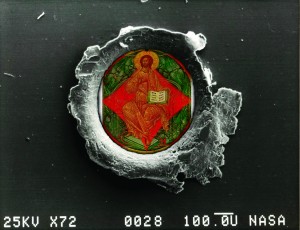
Just as I try not to tamper with the archetype as handed down by generations of Byzantine Icon Painters, I also try not to tamper with the recordings made by our modern high-tech celestial navigators. I’m forever hopeful that in this way the truth of both is maintained – even while a new original story – full of possibilities is created.
“Touchdown with Super Sonic Parachute” [Photoshop study]
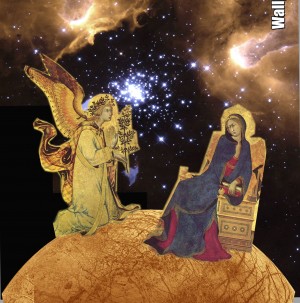
“Annunciation on Venus” [Photoshop Study]
“Trinity Sun” [Photoshop Study]
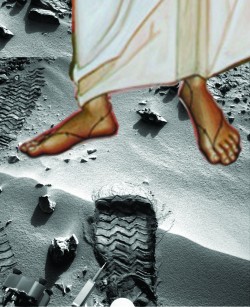
“Footprints of Celestial Travellers” [Photoshop Study]
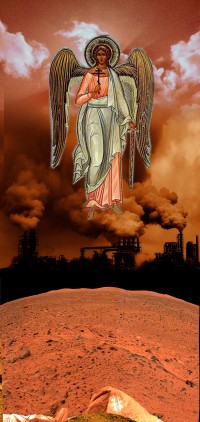
“Archangel Michael: Who is Like Unto the Sun” [Photoshop Study]
“Explorations of a Merciful Christ” [Photoshop Study]
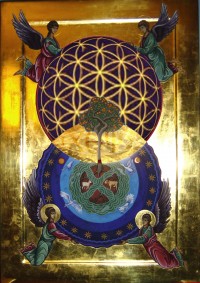
“Creation and Heaven Mandala Mandorla” [Photoshop Study]
“The Sign of the Moon Mother and Kea” [Photoshop Study]
In the July seminar at Whitecliffe College of Art and Design I exhibited for assessment two paintings. Today I would like to contemplate and discuss the painting of Cosmic Christ Transfigures on Mars.
G. Barnes. ‘Cosmic Christ Transfigures on Mars’ (Egg tempera and gold leaf on gesso, 45cm x 60cm)
This egg tempera painting on gesso board is a synthesis of two primary images. The Christ figure is from a byzantine sacred icon of ‘The Transfiguration of Christ on Mount Tabor’ and the landscape is appropriated from a NASA photo taken from their robot ‘Spirit’ as it travels across the terrain of the planet Mars.
Today, August the 6th, is the feast day of The Transfiguration in the Orthodox Church calendar. It is one of their principal feasts, and plays an important role in the Eastern Orthodox faith, as in this event Christ’s two natures are made clearly visible. In front of human witnesses – Christ exchanges his earthly form for his divine form and then returns to his earthly form. ‘According to the doctrine of Hesychasm the light which Christ radiated on Mount Tabor is eternal and is visible through reflection and introspection.’ (Roozemond-Van Ginhoven, p. 25)
Hesychia is the stillness and silence of inward prayer – waiting upon God in emptiness and quietness. Putting aside human thoughts and words. Also the original intention of the word metanoeo (the unfortunate word ‘repent’ is mainly used in English translations).
The gospels spell it out thus:
And Christ was transfigured before them (Peter, James and John): and his face did shine as the sun, and his raiment was as white as the light. … [Peter then expressed how good it was to be there and naively suggested perhaps they build some sort of altar??! GB] … While he yet spake, behold, a bright cloud overshadowed them: and behold a voice out of the cloud, which said, This is my beloved Son, in whom I Am well pleased; hear ye him. And when the disciples heard it, they fell on their faces and were sore afraid,” (Matt 17:2-7, Mark 9:2-13, Luke 9:28-36)
In my painting I have deferred from the original byzantine expression, with all the characters involved (see below) in order to focus on the sole figure and eternal moment of Transfiguration as expressed through the image of Christ. I have situated this event upon a landscape in the cosmos which no human eyes have beheld, or is likely to ever behold – in the camera we trust, just as in the enduring Archetype we may also trust. We are missing witnesses from the Transfiguration event, as we also we do not have verifiable witnesses of the planet Mars. The witness has become you, as you contemplate. Whether you trust the account of Mars, or the vision of the Godhead – is up to you.
The Transfiguration was not a phenomenon circumscribed in time and space; Christ underwent no change at that moment, even in His human nature, but change occurred in the awareness of the apostles, who for a time received the power to see their Master as He was, resplendent in the eternal light of the Godhead.’ (Lossky, p. 223)
Aidan Hart. “Transfiguration’
This cosmic Christ is a fully aware Being – a Human clothed in uncreated Glory – It was Light that the apostles saw – eternal, infinite, existing outside space and time. It is divine and uncreated. Terrifying and unbearable to the apostles, being so foreign to human nature. Only one character within the Judaic-Christian revelations was never ever struck down and blinded by this Light when revealed – and that is the underrated figure of Mary Magdalene – certainly a subject for another painting!
Revealing himself through His creative ‘thought-wills’, God can be known in creatures and by means of creatures, but He can also be known immediately by mystical contemplation, in His uncreated energies which are the splendour of His face. It is thus, in His Godhead, that Christ appeared to the apostles on Mount Tabor, and it is thus that He makes Himself known to the saints who detach themselves from all created things, renouncing all finite knowledge in order to attain to union with God …. We are reminded here of the ecstasy of St. Benedict of Nursia, who saw the whole universe as if it had been gathered together into a beam of the divine light. (Lossky, p. 99)
Dionysius the Areopagite, also spoke of ‘rays of divinity’. He is a fascinating figure from the very early days of Christian revelation, (in either the 1st or 4th century – there is debate about the time he wrote). Dionysius wrote of the creative powers which penetrate throughout the universe, and make themselves known, not through any created being, but by an interior light. His work primarily questions the ability to represent God in a material way. On further reading of his work, one is led to think that images of the Godhead, sacred icons, and other human representations of Divinity must have abounded at the time. Possibly most of these images were destroyed during the iconoclasm?
And when we have received, with immaterial and unflinching mental eyes, the gift of Light, primal and super-primal, of the supremely Divine Father, which manifests to us the most blessed Hierarchies of the Angels in types and symbols, let us then, from it, be elevated to its simple splendour …. For it is not possible that the supremely Divine Ray should otherwise illuminate us, except so far as it is enveloped, for the purpose of instruction, in variegated sacred veils, and arranged naturally and appropriately, for such as we are, by paternal forethought. (Dionysius, Ch.1 Sc. 1)
Surely these ‘rays’ penetrate the entire solar system? And yet they are variegated, veiled – for our safety perhaps. And as we humans make our fledging and clumsy explorations of space – we only learn how little it is that we know for sure. The universe does not shed her veils easily either. But this is actually the essence of it – the Transfiguring Christ and the photo of a Mars Landscape are both mysterious encounters. Heaven intersecting Creation. Positioning this intersection on Mars requires us to blow apart the Heaven and Earth dichotomy we have grown up with, and enables us to swing our brains around differently. Because – up there – is also ‘earth’ or Creation. It requires us to look elsewhere for ‘heaven’ – and not just UP. Heaven is within us? All around, embedded in the fabric of space. Creation is Matter /Elements. Is Heaven is the Space/Energy in between?
What is a mystery? A mystery is something that is ‘revealed for our understanding, but which we can never understand exhaustively.’ It leads us into the depth, and into the darkness of God. ‘The eyes are closed – but they are also opened’ (Ware, p. 15). Bishop Kallistos Ware also refers to a term which helps me to fathom this way of unknowing which he calls ‘thick darkness’ or ‘dazzling darkness.’ I think humanity also fathoms space in the same light (darkness). The plethora of strange worlds and alien creatures we have invented to inhabit the cosmos is a measure of the impenetrability of the universe.
Why is this starting to sound like a sermon? Well, I think the work of the artist is indeed the same as the theologian. We are trying to describe transcendence and find a way to express the mysterious tremendum. Is this also the work of that modern invention – the Contemporary Artist? We heard from two contemporary artists during the seminar whose practise is also one of exploring mystery.
During the seminar, artist and conjuror, Dane Mitchell spoke of his art as a means to ‘invoke some unseen thing; and to ‘illuminate illuminations.’ He talked of ‘mystic states’ and ‘revelation vs. concealment.’ The language of a theologian practising art – surely? But while Mitchell provides the ‘containers’ of the artwork, in the form of glass cases, white rooms or boxes – he employs mystic practitioners to fill them up with ghosts, hauntings, and other unseen presences. He specifies the time and place – but the artwork is ‘activated’ by the rituals of practitioners who have already built gateways to the etheric realm.
Mitchell is not the conjuror, he is merely the means by which the conjuring is revealed. He is not even providing a tunnel, or a path, or a window to this world. But a box. Mitchell encapsulates everything in containment, creating well defined boundaries in order to confine. Borders provide the security of a spatial fastening to the tangible – is it only within the cognizant spatial borders of our lives that we feel safe? An etheric world of ghosts and hauntings without boundary is truly terrifying, indeed probably the stuff that mythologies of Hell are built upon. His practise seems to be an exercise in terror remediation – a kind of dampening down rather than an opening up of theological enquiry.
Australian media artist Grant Stevens confessed to being afraid of the ‘power of the image’ early in his career and so he abandoned it in favour of text, primarily animated cosmic clusters of text in video projections. Nevertheless, and contrarily, he is quite unafraid to explore raw authentic human emotion. His work deals with issues of love and loss, annoying mental thoughts, sanity, death. At once very profound, and also quite banal. Is he trying to go beyond the ‘supermundane’, as Dionysius calls it, of symbol and image, and raise our mind to a contemplation of heavenly things without ‘material guidance’ – beyond the imitation?
Wherefore, the Divine Institution of sacred Rites, having deemed it worthy of the supermundane imitation of the Heavenly Hierarchies, and having depicted the aforesaid immaterial Hierarchies in material figures and bodily compositions, in order that we might be borne, as far as our capacity permits, from the most sacred pictures to the instructions and similitudes without symbol and without type, transmitted to us our most Holy Hierarchy. For it is not possible for our mind to be raised to that immaterial representation and contemplation of the Heavenly Hierarchies, without using the material guidance suitable to itself,’ (Dionysius, Ch1)
Is it possible to do this? Dionysius suggests it is not. Can we depict transcendence without material figures and bodily compositions, to have revelation without symbol, without type? What is that then???! It’s quite a journey for an artist, who is up to it? I will continue to wrestle with the Image, and I will banish all borders in the Dark. : )
‘The darkness is not the absence of light, but the terror that comes from blinding light.’ Jacob Boehme
‘... every procession of illuminating light, proceeding from the Father, whilst visiting us as a gift of goodness, restores us again gradually as an unifying power, and turns us to the oneness of our conducting Father, and to a deifying simplicity.’ Dionysius
REFERENCES
Dionysius the Areopagite, Works (1899) The Celestial Hierarchy. Vol. 2. p.1-66.
Lossky, Vladimir (1976) The Mystical Theology of the Eastern Church. St Vladimirs Seminary Press: New York
Roozemond-Van Ginhoven, Hetty J. (1980) Ikon: Inspired Art. De Wijenburgh: Netherlands.
Ware, Bishop Kallistos (1979) The Orthodox Way. St Vladimirs Seminary Press: New York








 Gaylene Anne Barnes